

Fancy a bit of vintage travel and panoramic views along with the sun and sea on your Portugal trip? You’ll love Lisbon, says Jill Theobald
A city built on seven hills. Dining out in style. Lots of walking – or travelling by tram. Exploring converted warehouses full of artists, makers, stalls, and shops. Street art around every corner. Oh, and soaking up lots of sunshine.
Swapping Sheffield for Lisbon for a long weekend saw my travelling chum and unLTD contributor Stella Bolam and I end up with a daily itinerary that wouldn’t be too dissimilar to that of visitors to our beloved home city right here in South Yorkshire.
Well, all except for the last one maybe…
Plus our charming Air B&B host might well challenge the first one, while we’re at it – he told us that the seven hills of Lisbon are actually two mountains.

That was after we all got our breath back after walking up four flights of stairs with lots of luggage – my fault, I chose the place based on online photos of the view from the bedroom window, and you don’t tend to get stunning views without walking up a lot of stairs. Our apartment building had survived Lisbon’s great earthquake of 1755, but it was doubtful it would tolerate the installation of a lift, he admitted).
There’s a lot of walking to be done in general along Lisbon’s lovely cobbled pathways and we packed a fair bit into our long weekend. But it was tricky to do everything on our To Do list.
Despite it being March – or Portugal’s winter, as our host pointed out. Not to two residents of northern England, we replied! – it was definitely t-shirt weather, so we wanted to get out and about as much as possible and had to give museums like Museu De Artes Decorativas Portuguesas a miss, despite being tempted by its haul of 15th-19th century art, including textiles, furniture, painting, jewellery and ceramics.
So here instead are our top five highlights.
- Elevador de Santa Justa
And what a ‘high’light indeed to kick off with – The Elevador de Santa Justa is a 19th century Neo-Gothic lift that transports passengers up the steep hill from the Baixa district to the Largo do Carmo and the ruins of the Carmo church.
One of the city’s most loved landmarks, it was built in 1902 by the Portugal-born French architect Raoul de Mesnier du Ponsard, an apprentice of Gustave Eiffel, and while queuing and gazing up at the wrought-iron lift waiting for our turn to be whisked up in the polished wood carriage it was not hard to see the striking similarities in its neo-gothic and geometric arches.
Get there early in the morning or evening to avoid the really lengthy queues, but definitely worth the wait – the viewing platform alone on the 147ft high tower is very snap-happy and for a euro or two extra, the top of the tower, reached via a spiral staircase, has gorgeous views of the city, including Rossio Square, the castle and the river.
- Tram / funicular railway

The Rua Augusta Arch with one of Lisbon's famous yellow trams
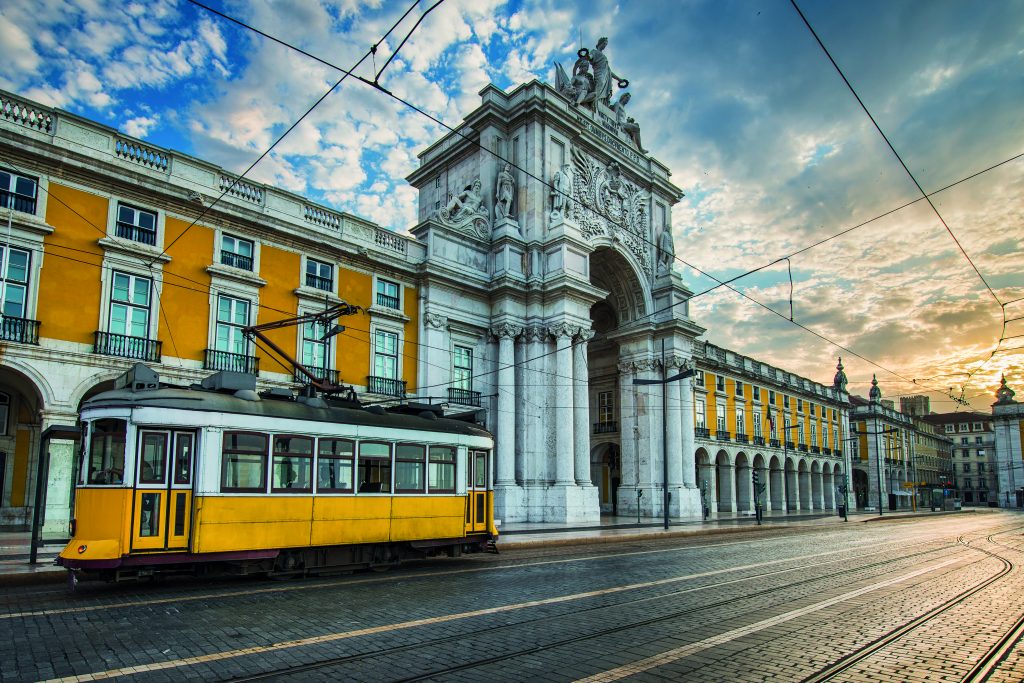
The tram is a must-travel option while you’re in Lisbon. The distinctive yellow number 28 Lisbon tram passes through the popular tourist districts of Graca, Alfama, Baixa and Estrela and a ride along the entire 28 tram route provides one of the best tours of the capital.
The quaint Remodelado trams date from the 1930s, and despite their age the historic trams are still in use, as the 28 route is unsuitable for modern trams, due to its tight turns and narrow streets.
We hopped on and off after buying a 24-hour travel ticket which gave us trips galore on the tram, the funicular railway and even entry to the Elevador de Santa Justa. Top value for money.
The funicular we discovered round the wrong way – after traipsing up what must have been one of our host’s aforementioned mountains, we realised we could have got the funicular! But enjoyed our trip back down past street art and murals a-plenty.
- Lisbon castle, the Castelo de Sao Jorge
Lisbon castle, the Castelo de Sao Jorge, stands majestically above central Lisbon … and so up another big hill! Located on the peak of the São Jorge, Lisbon's highest hill, it can be a long walk but as the ancient seat of power for Portugal for over 400 years, it’s the one of the most popular tourist sites in Lisbon. The extensive castle site with its eleven towers will take up a lot of your time, but we found the views from the grounds alone pretty spectacular and enjoyed taking a walk along some of the surrounding streets.
- LxFactory
Probably my personal highlight (and recommended by another fellow unLTD colleague, graphic designer Simon Garlick) – LxFactory is an abandoned site in the industrial area of Alcântara transformed into a creative, cultural and gastronomic area.
A ‘creative island’, the restored factory warehouse complex is home to companies and offices, more than 50 shops, bars, restaurants and also plays host to a diverse range of events in advertising, multimedia, art, architecture, and music. We visited on Sunday so got to sample the delights of the ‘Sunday hippie chic market’, and ate some lovely local fare at the cantina.
- Praça do Comércio
The Praça do Comércio was constructed in 1755 after the great earthquake destroyed the entire Baixa district including the Royal Palace. To the north is the is the Rua Augusta Arch that gives way to the boulevard Rua Augusta full of shops, as well as trams that head west to the Belem district – where we headed to LxFactory. At the southern side is a ferry terminal that crosses the River Tagus and we were lucky enough to catch a live band playing by the shore.
It being Lisbon’s main square, we thought grabbing an afternoon drink or two at one of the bars dotted around might be pricey and were pleasantly surprised to find it fairly reasonable for such a tourist hotspot – and sun trap.