It was a stroke of serendipity that brought me face-to-face with the work of Flourish. In the same week I was due to speak to the charity, I found myself interviewing 23-year-old Lucas Ashman, one half of Sheffield hip hop duo Ree-no. Lucas, or Lukey D, shared how he was first introduced to music through a group run by Lucy Revis – a former Flourish worker who now runs Tracks music school.
That introduction sparked a new creative path for Lucas – but as Josie Soutar, Managing Director of Flourish, rightly points out, success stories at Flourish aren’t always about record deals or careers launched. They’re about connection, community and simply showing up.
Since 2012, Sheffield-based mental health charity Flourish has supported people affected by mental health challenges to live the lives they want, using creative, mental health-friendly activities, co-production and digital tools. As Josie explains: “We grew out of Sheffield Health and Social Care, but there was a recognition that NHS services, while essential, are limited. They’re brilliant at the medical model – diagnosis, medication – but the social side of mental health is better met in the voluntary sector.”
Today, Flourish works across three key areas. The first is providing mental health-friendly groups and spaces. These are free, community-led activities like art, football and music sessions. “You’re not your mental health condition when you’re here,” Josie says. “If your behaviour is slightly different to what society expects, that’s fine – this is a safe space.” The groups are often co-designed and run by people with lived experience of mental health difficulties. It’s about creating non-judgemental environments where everyone feels welcome.
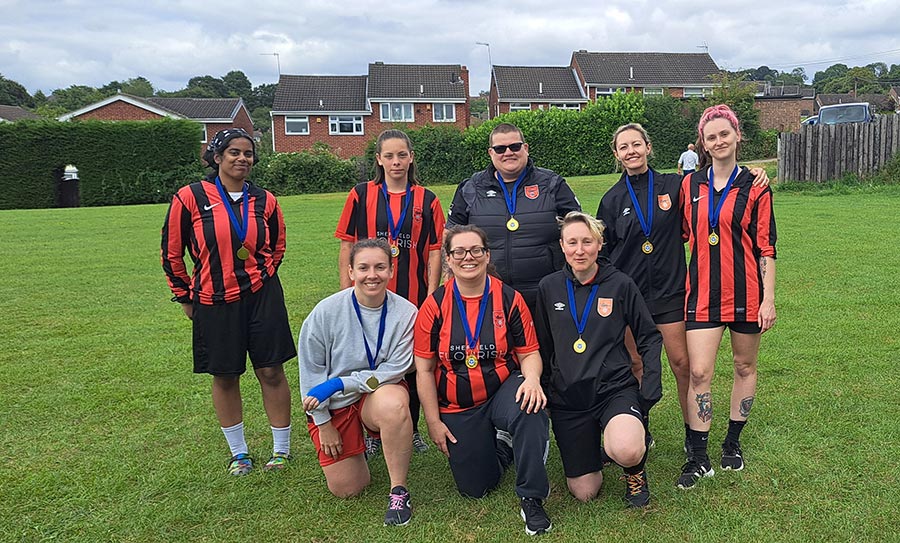
The value of these spaces can’t be overstated. As one participant put it: “The art group pretty much saved my life. I’ve been a lot less paranoid and depressed and had less delusions. I always look forward to coming.” Another added, “Flourish have created such an important, safe and friendly environment for so many different women to play the game.” That game is Wednesday night football – where, as Josie shares, one woman who rarely leaves the house comes out each week just to play. “That might not be playing for the Lionesses, but to us and her, it’s massive.”
The second strand is digital resources – most notably, the Sheffield Mental Health Guide, an online directory of over 300 local services. It’s searchable by condition, identity or need. “You can put in ‘men’ and get men’s groups, or ‘African’ and find relevant support,” Josie explains. There’s also the Sheffield Suicide Support and Prevention site, where people can build safety plans, find urgent help or access free training. “We’re trying to lift the lid on silence – the worst thing we can do is not talk about suicide.”

Both sites are supported by a helpline and live chat, and for those who prefer offline access, paper guides are available in local libraries or by request. The charity has also produced a new leaflet that breaks down how mental health support in Sheffield works – what the NHS offers, what the council provides and what charities do – in accessible, jargon-free language. “The Mental Health Guide works well,” says one user. “It’s not patronising but still suitable for lots of different people of all ages and literacy, and it doesn’t look cold and clinical.”
The third area is co-production – working with people with lived experience to shape the design of mental health services. Recently, this involved speaking to over 400 Sheffielders about a new 24/7 mental health hub being built in Newfield Green. “If you ask doctors to design a space, it can end up looking like a GP clinic. We wanted to ask people what would actually help them.”

Josie’s own role as MD, she jokes, is a “grandiose title for jack of all trades, master of none.” But in truth, she’s responsible for everything from fundraising to partnerships and policy – including, most recently, writing an AI policy by testing how tools respond to mental health queries. She’s also deeply involved in race equity work: “Around 75% of patients in mental health wards are non-white, but most groups in the community are white. So we’re looking at how we amplify the voices of smaller organisations rooted in those communities.”
The charity’s current focus is visibility – making sure people know what’s available before they reach crisis point. “One of our biggest aims is to dispel the myth that getting better starts with a diagnosis,” says Josie. “You don’t have to wait for a GP referral – you can help yourself now.” The tools and guides are there, whether digital or in print, and the groups are open and free. “You don’t need to prove you’re ‘mental enough’. If you think a group would help your wellbeing, you’re welcome.”
The benefits go beyond therapy – they’re social, emotional, even playful. “Even if I’m in a really shit mood,” says Josie, “just being around people, having a bit of nonsense and silliness, is really important.”
And while the Flourish community doesn’t expect every participant to walk away with a creative career, stories like Lucas’s are still reminders of what’s possible when people are given space to explore their passions. “Sometimes just showing up is everything.” Josie smiles.
To find out more or to explore the resources and groups on offer, visit:sheffieldmentalhealth.co.uk