Words: Rosie Brennan
£1.5 billion has been awarded to South Yorkshire by the government for upcoming transport projects. But what could this mean in practice?
The chief executive of Sheffield City Council, Kate Josephs, recently welcomed the funding, which comes as part of the government’s £15 billion investment in transport projects announced in June, describing it as “game-changing”.
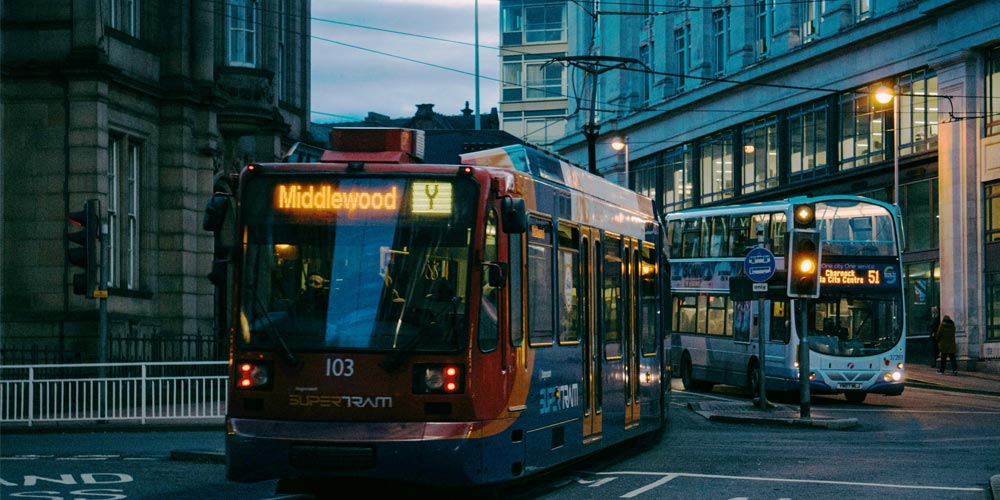
A press release stated that £1.5 billion will be spent on upgrades to the bus and tram network in Sheffield and the wider South Yorkshire region. More specifically, that will include £530 million to update the tram network with new vehicles, modernised platforms and essential maintenance to improve reliability, as well as £350 million for the electrification and general improvement of buses.
Dr Sam Chapman, co-founder and director of The Floow, is co-chair of the Transport Forum, facilitated by Sheffield Chamber of Commerce. When asked for his reaction to the news, he told unLTD: “We’ve been calling out for increased funding … it has been lacking for a long time and is desperately needed. People are reliant on their cars because they don’t feel the service is good enough.”
Dr Chapman explained that as well as the improvements to bus and tram stops, there are plans under way to upgrade the tracks, which were originally installed in 1994. “Exact details are still being refined, but we’re aiming to deliver it all as quickly as possible – the realistic timeline is from now until 2027,” he said.

Kate Josephs also commented: “The money will support significant improvements to our buses, including brand new electric vehicles under public control, helping to clean up the air we breathe at the same time.”

Highlighting the impact switching to electric vehicles could have on public health as well as the environment, Dr Chapman said: “It’s fundamentally harming people’s health – 500 people in Sheffield die per year directly due to air quality. Things like this and the Clean Air Zone aim to make a difference.”
In addition to improved air quality, the funding is expected to bring positive outcomes for the economy and productivity across South Yorkshire. “We’re transforming it from an aged fleet into a system with less risk, which allows for more productivity,” said Dr Chapman. “We’ve been fundamentally operating at risk; passenger numbers have been declining. We can address the important parts, building and improving the economy.
“It’s a cycle – expenditure unlocks productivity. A lack of expenditure means more people driving cars, more air pollution, more congestion, and less productivity.
“I think it’s fantastic, but it also should be normal. We’re addressing a gap.
“You look at government spending – the average spent on transport in South Yorkshire and the Humber in 2023/24 was £495 per person. The average across the UK is £687 per person. In London, it’s £1,313. That gives you the historic picture – there’s a lot more to do.
“The intention is to correct how funding has been distributed, which hasn’t always been in the best interests of fair investment for transport.”
Reflecting on comparisons to southern regions such as London, he added: “Areas that have invested in light rail have made huge changes to their economy.”
Looking at what South Yorkshire needs as a region, he said: “It won’t be made into a perfect system. There is more to be done. We’re building foundational plans for what may come next, with future funding for expansion.”
Nonetheless, it’s a positive first stop on the journey towards a transport system that’s “cleaner, greener, inclusive, fair and ready for growth.”