
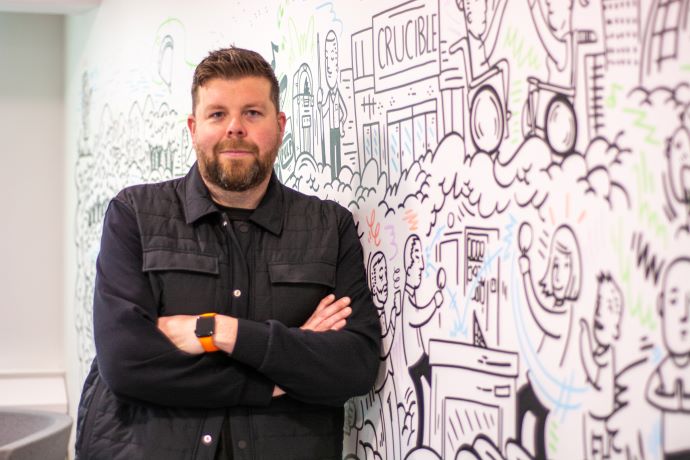
Seven years after officially launching LensGo, filmmaker and storyteller Stuart Turner still has moments where he stops, looks around and thinks: Is this really my job? The founder of the award-winning South Yorkshire visual media company has built a business that now works across elite sport, major charities, construction, entertainment, tourism and some of the region’s biggest brands. Yet behind the cameras and campaigns is a journey shaped by instinct, hard graft, one extraordinary early phone call and, perhaps most of all, a rare ability to see and share people’s stories.
“It’s been unbelievable. I pinch myself every day,” he says as we settle down for a chat at Westfield House in Sheffield city centre.
Stuart had been freelancing for years when the opportunity to take the next step finally crystallised. “The opportunities arose, I was growing rapidly and I needed to go to that next level, really. And that’s why I decided to make it official,” he recalls.

LensGo was born in 2018. What he did not expect was that, just a week later, the sliding door would swing open with the force of an arena stage spotlight.
Within days of setting up, he received a call from Def Leppard’s tour management asking if his company could film the band’s Teenage Cancer Trust concert at the Royal Albert Hall. “All of a sudden it was, we want seven camera operators. We want multicam live feed. We want edits… It’s easy setting up a business if you get a call like this,” he laughs.
Of course, he immediately said yes, worked out the logistics later and found himself with seven camera operators running through backstage corridors as the likes of The Who and Kasabian brushed past. It was a case of baptism, meet fire.
“It really was my first taste of not only dealing with a big band, their agents and managers, but also dealing on the charity side with the Teenage Cancer Trust,” he says. That project, he adds, became the catalyst for a deep, long-lasting commitment to charity storytelling that still defines LensGo today.
However, the early years were not all rock concerts and high-profile campaigns. Like every emerging business, particularly in creative industries, the company hit the wall in 2020.
“Obviously there was no more on-site film,” Stuart says. “Events stopped, concerts stopped, couldn’t go into the charities we work with, sport stopped… So, yeah, it was about adapting.”
Adapt they did. Almost overnight, organisations needed live-streaming, remote production and online engagement to stay connected with their audiences. Stuart found himself filming in silent football stadiums, hosting virtual events for charities and moving pretty much everything online.
All this happened while navigating his own life-changing moment. “My son was born as well, on the first day of lockdown,” he says. “It was scary times!”
Yet through the turbulence, something solid began to form. The clients who relied on LensGo during the pandemic are, in many cases, still clients today.

Today, they operate with a core team of five freelance creatives. It is an intentional model, built for agility and chosen to give opportunities to emerging talent.
“Motivation comes from allowing them to be creative… and giving opportunities they might not necessarily have before,” Stuart says.
That commitment stems from his own early experiences in the industry. “Something I never had and something I had to learn myself,” he adds.
The team has grown in confidence and skill to the point that clients now recognise LensGo not as a one-man outfit but as a collective of specialists. And in recent months, Stuart has made a conscious effort to shift the spotlight.
“As much as I like getting the limelight, it’s nice that we’re showing more of the team. People are now getting to know LensGo, not just Stuart.”

In a region full of creative talent, LensGo has carved a prominent position. Much of that success comes down to relationships – the very thing Stuart values most.
“I’ve always been very much a people person,” he says. “Our clients recommend us to their clients. It’s grown like that, really. We’ve almost got this LensGo fan club now”.
It shows. Their client list now includes Gulliver’s Theme Parks, Sheffield Chamber, City Taxis, Virgin Media, IKEA and Sheffield Wednesday. The company’s work with Gulliver’s, documenting the build of its Rother Valley theme park, opened the door to construction clients. Its charity campaigns led to awards and high-impact fundraising totals. And social media, Stuart notes, remains the company’s most effective marketing tool.
“Ultimately, social media is how we’ve grown,” he says. “The stuff that I’ve been able to put out has constantly led to more messages, more leads, more interactions.”

If there is one constant across the seven years, it is a deep connection to local charities. The work is hugely rewarding, of course, but it brings its own challenges too.
“We’ve been in some really tough situations,” he says sincerely. “We’ve literally had to interview someone who might just have lost their son or daughter… or might be dying themselves.”
Those conversations, he admits, stay with you. After filming at Bluebell Wood Children’s Hospice shortly after the birth of his son, he sat in his car and cried. “It puts everything into perspective,” he says. But the outcome – the money raised, the awareness generated, the support delivered – makes every difficult moment worthwhile.
“Some of the videos we’ve done for charities have won awards, and the fundraising that’s come off the back of that is just unbelievable.”

LensGo now works closely with Sheffield Hospitals Charity, Sheffield Children’s Hospital Charity, Paces and others. Their work has recently appeared on the big screens during the Sheffield derby.
Beyond the cameras, Stuart speaks openly about something that matters deeply to him: men’s mental health.
“I’ve had some dark moments,” he says. "It’s easier for me to talk now, and I’m always encouraging others to do the same.”
His routines today reflect that commitment to balance. School runs, swimming, time with family and friends, and space to prioritise his wellbeing are no longer optional extras. They are non-negotiables.
His openness, he hopes, sets a tone that encourages his team and clients to feel comfortable doing the same.

As for what comes next, 2026 looks like an exciting one. Much of that centres on major investment and redevelopment across Sheffield’s hospitals and children’s services, where LensGo will be capturing the transformation as it unfolds .
That future growth, he believes, will come from the same place it always has – telling powerful human stories and building genuine relationships.
Every Inside Track interview ends with a final question: if you could create one rule everyone had to live by, what would it be? And he answers without hesitation.
“Well, most people that see me at events would know that Jägerbombs are pretty mandatory!”
As rules go, it may not make statute books. But in Stuart Turner’s world – where creativity, community and connection matter the most – it fits perfectly.
Listen to the full interview here.
Get in touch with LensGo here.