
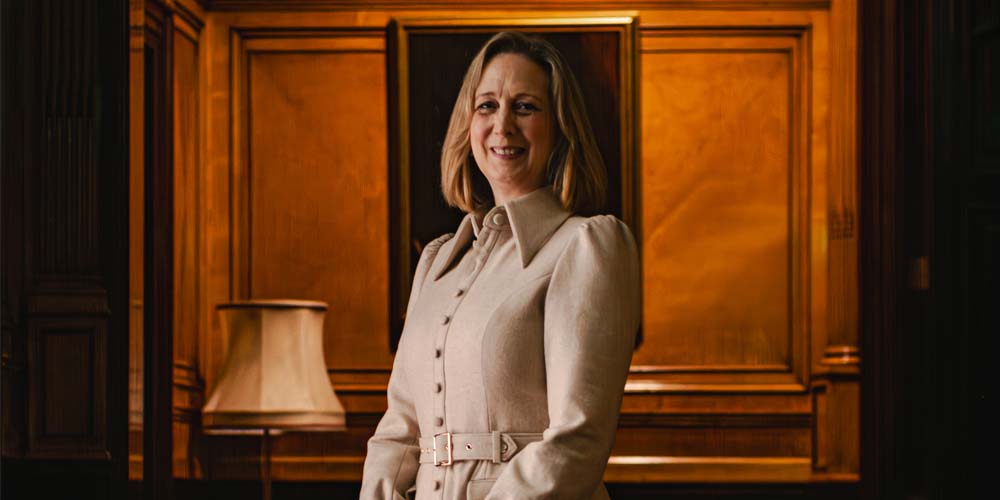

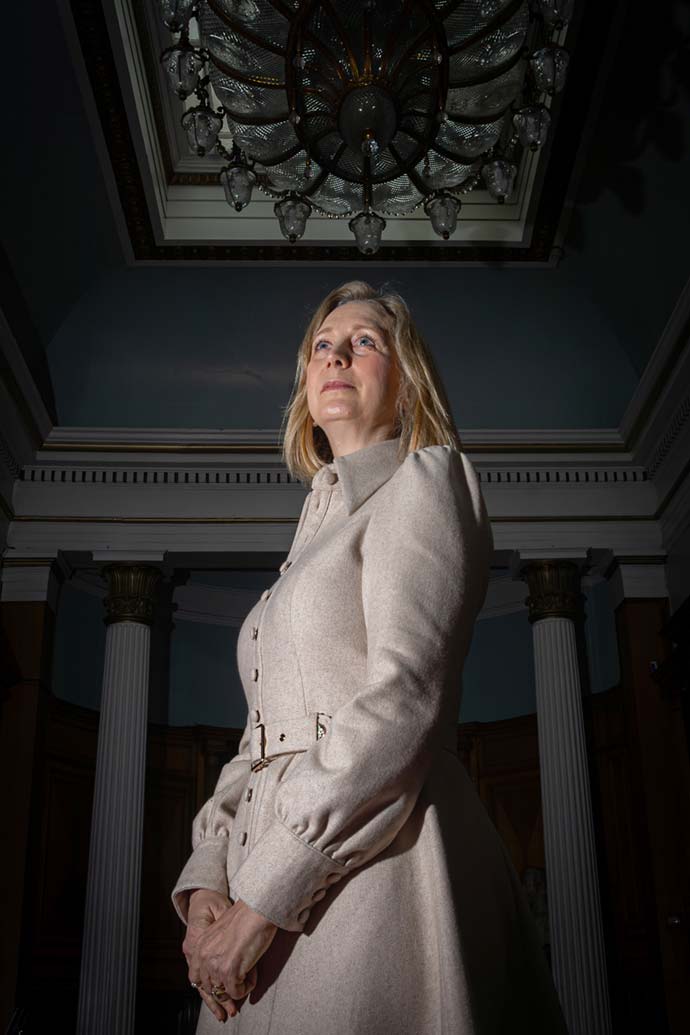
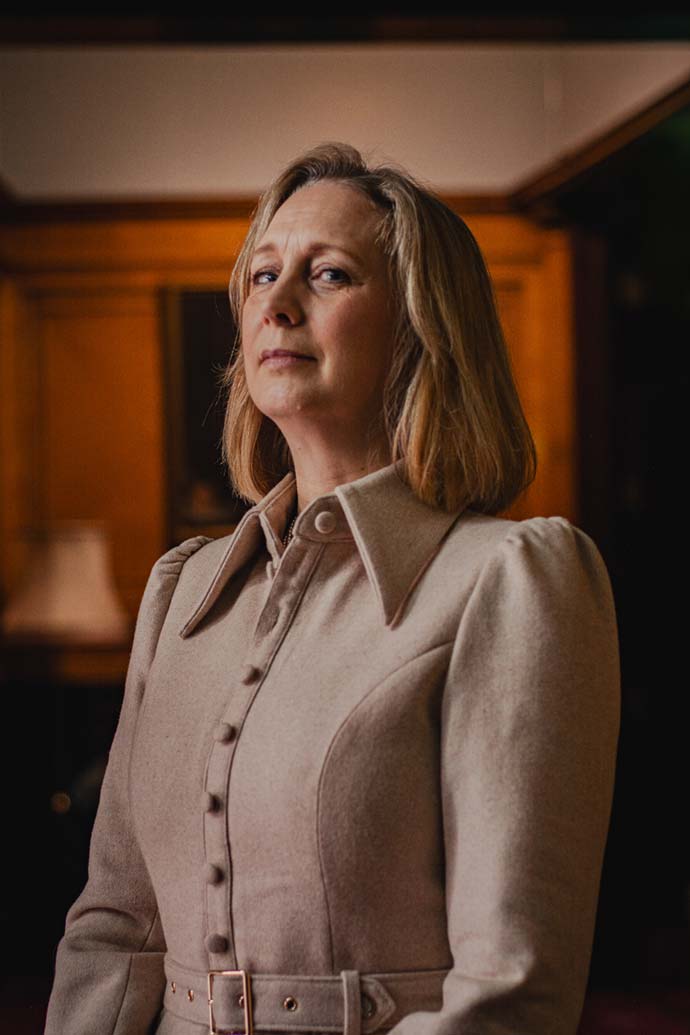
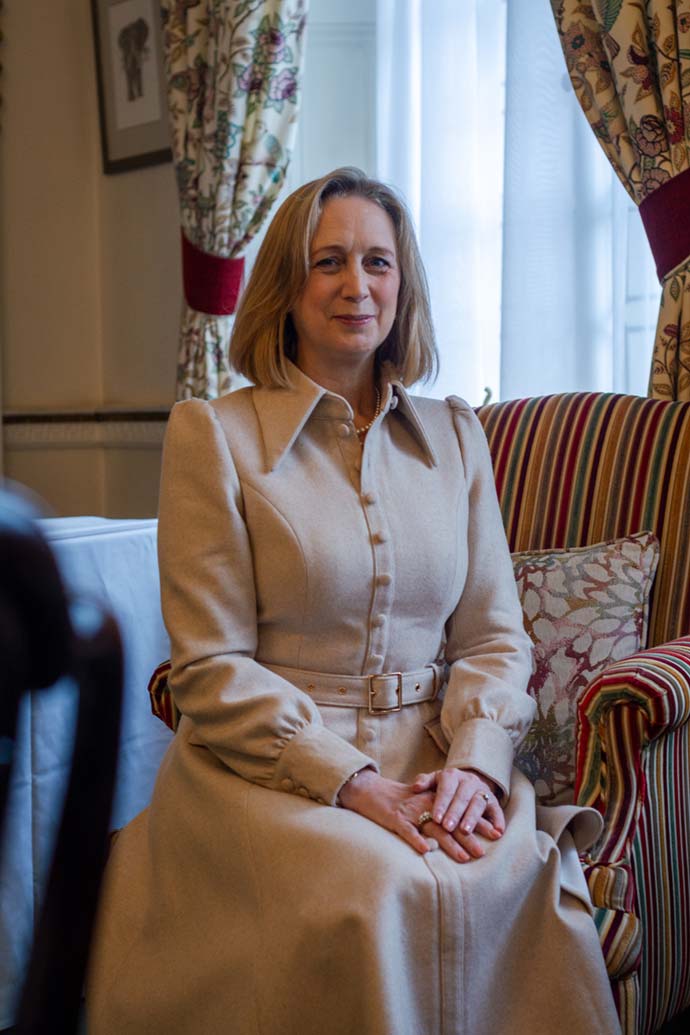
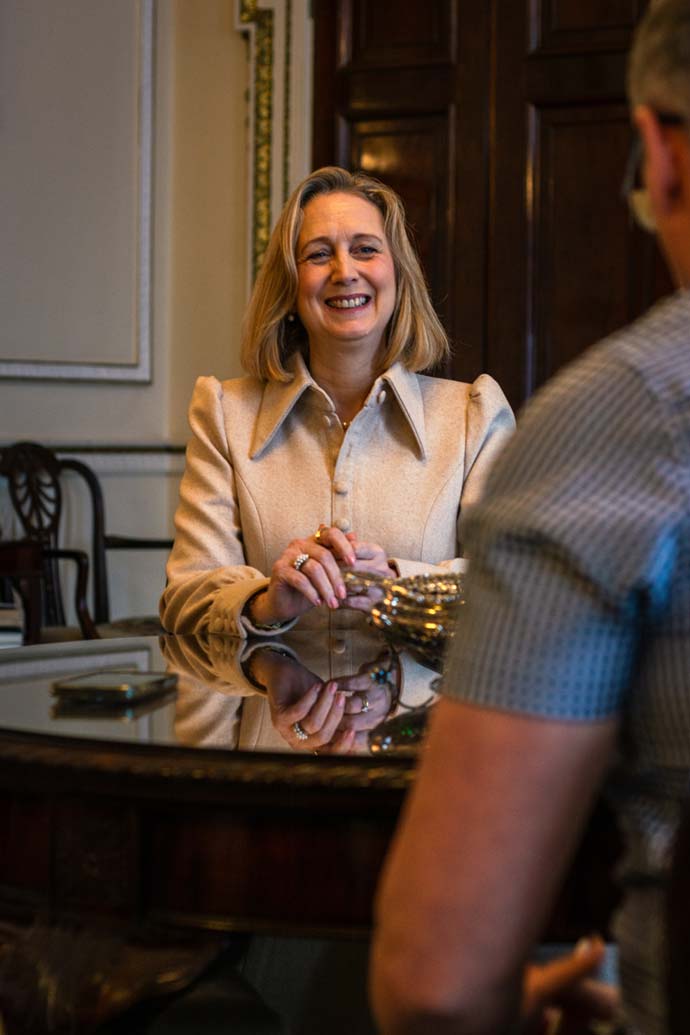
She never planned to become an accountant. But more than 30 years on, Victoria Clarke Brown has built a career across global manufacturing, boardrooms and civic leadership – and is now on course to become Master Cutler. For the latest Inside Track interview, Russ and Victoria spoke about accidental beginnings, Sheffield’s business community and why leaders should spend time at the coalface.
Victoria Clarke Brown didn’t set out to work in finance. In fact, the career she has built over the past three decades – spanning global manufacturing, acquisitions, private equity exits and a number of civic roles – began almost entirely by chance.
“My degree is in geology and geography,” she says. “So I suppose you’d say I’m an accidental accountant.”
After graduating from the University of Birmingham, she assumed the next step would arrive quickly. Instead, she spent a year pulling pints at her local pub while working out what to do next.
“I genuinely thought there’d be a queue of employers waiting for me at the end of my degree,” she says. “Unfortunately that wasn’t the case.”

It turned out to be a valuable year. The work was demanding, but it also taught her something she still relies on today.
“I loved it. It was great for people skills. It was hard work though – split shifts are not fun.”
The change in direction came thanks to one of the regulars, who offered her a role in data analysis at Group 4 Court Services (later G4S). The work quickly proved manageable, and within weeks she was completing most of her tasks by midweek. Because she was based at head office, she found herself surrounded by senior leadership, including the finance director. Conversations began, first casually and then more regularly, and before long she was helping him with project work for the rest of the week.
A few months later he asked a question that would change the course of her career.
“Would you like to be an accountant?”
Her answer, she admits, was instinctive.
“As only a 21-year-old can say – ‘God, no.’”
But when the offer included funded training, it suddenly became a much more attractive proposition. Victoria chose to study CIMA, knowing she wanted to remain in industry rather than move into practice. From that moment on, things started to fall into place.
“I never looked back.”
In the early years of her career she moved between roles to gain experience across different parts of the business before securing her first post-qualified role at engineering firm AES. She stayed there for nine years, working with leaders who left a lasting impression.
“I loved it,” she says. “I worked with some amazing people. It’s a fantastic company.”
But after nearly a decade she began to feel ready for something new. Large organisations can sometimes offer stability at the expense of progression.
“Once you’re in, you’re in,” she says. “Progression wasn’t as quick as I needed it to be.”
Her next move was to multinational ingredients group Kerry, which offered a much larger global environment and the chance to broaden her experience. By that point she had already developed a particular skill set around acquisitions. During her time at AES she had worked on the purchase of around a dozen subsidiaries, and that experience began to define her role.
Working within a major multinational also made her realise something important about how she prefers to operate.
“What that taught me was that being a small cog in a massive multinational doesn’t suit my personality at all.”
When the company’s head office relocation threatened to take her to Ireland, she made a decision that would shape the rest of her career. Sheffield, she realised, was where she wanted to be.
Returning to South Yorkshire, Victoria stepped into her first finance director role. It was a baptism of fire. Within three months the company was navigating a management buyout, an experience that immediately tested her commercial and leadership skills.
She remained there for six years, helping guide the business through two of the most disruptive events modern companies have faced: Brexit and the Covid-19 pandemic. During the early months of Covid, much of the workforce had been furloughed, leaving a very small leadership team to keep the organisation running.
“It was basically me and our HR director managing the business,” she explains. “I was focused on protecting cash flow and protecting the supply chain.”
When the immediate crisis eventually passed, she found herself reflecting on what came next. Looking at the company’s long-term plans, she realised she had reached a natural point of transition.
“We were looking at the five-year plan and I realised I’d learned everything I could there.”
It wasn’t an easy decision. She was also a shareholder, which made walking away more significant. But she chose to take several months out to think carefully about the next phase of her career.
That reflection led her to Custom Solar, a fast-growing renewable energy business in Chesterfield where she joined as employee number 10. It was a very different environment from the large corporates she had worked in before, and one she immediately enjoyed.
Her role included refinancing the company to support its growth. As the business expanded, acquisition offers soon followed, and the company was eventually sold to Mitie. Victoria had already made it clear that she would move on once the transaction was completed.
“I didn’t want to go back into a large corporation where I’d be running a small subsidiary.”
Her next role took her to Special Melted Products, where she was brought in by private equity investors to prepare the business for sale. It was an intense period of work, but one that ultimately delivered results.
“It was hard work,” she reflects. “But we knuckled down and got everything in place.”
The company was later sold to a Taiwanese group at a significant multiplier.
Today she is finance director at Sheffield sportswear brand Kitlocker, a move driven less by strategy than by culture.
“I moved there because of the people. Mike and Tom, who own the business, are phenomenal. They really care about their team.”
Alongside her executive roles, Victoria has developed a wide portfolio of civic and non-executive positions. She is an ambassador for the Institute of Directors, independent chair of the HLM Architects Employee Ownership Trust, a trustee of the South Yorkshire Community Foundation and a Guardian of the Sheffield Assay Office. She also recently joined the board of IntelliAM, a Sheffield-based digital manufacturing company working with global industrial clients.
“I wear a lot of hats,” she admits with a smile. “But I love each of them because they all bring something different.”
Much of that activity reflects her deep connection to the city itself.
“Sheffield’s a good place to do business,” she says. “If I ever have a problem I need help with, there are always people I can call who will give really good advice.”
One of the people who had a significant influence on her was the late
Julie Kenny CBE, the widely respected South Yorkshire business leader who championed women in industry.
“Julie was an amazing woman – an absolute powerhouse,” Victoria says.
Julie was instrumental in encouraging the creation of Women of the Cutlers’, a network designed to support women working across manufacturing and business in the region.
The group now includes more than 80 members and provides a supportive space for women across the region to connect and share advice.
Victoria herself is also part of the leadership structure of the Company of Cutlers in Hallamshire. Currently serving as Junior Warden, she is progressing towards becoming Master Cutler – subject to election – in 2027. For someone who grew up in Stocksbridge, the role carries deep personal meaning.
“My dad worked at Stocksbridge steelworks all his life,” she says. “Steel is in my blood.”
To represent the region’s manufacturing heritage, she says, would be a tremendous privilege.
“To be the voice of manufacturing for the region would be a huge honour.”
Leadership, in her view, starts with understanding your own strengths and limitations. Rather than trying to master every aspect of a business, she prefers to build teams that complement each other.
“I know what my strengths are and what my weaknesses are – so I surround myself with people who are strong where I’m not.”
That philosophy also shapes the boards she sits on. The strongest organisations, she believes, are those where different perspectives are actively encouraged rather than suppressed.
Transparency is equally important when organisations are facing change.
“If people understand why change is happening and where you’re heading, they’re much more comfortable with it. You have to take people on the journey.”
Victoria is optimistic about the future of business, particularly when she looks at the generation now entering the workforce.
“They’re far more accepting of different lifestyles and different mindsets – and they’re much more willing to question the balance between work and life.”
For Victoria, leadership now also means making the path easier for those who follow.
“I hope I can make other people’s journeys a bit easier than mine was,” she says. “That’s part of leadership when you get to this stage.”
Before we finish, I ask the same question I ask everyone in this series: if she could introduce one rule that every leader had to follow, what would it be?
“Every leader has to spend a week a year at the coalface of their business to really understand what they are asking of their team” is the quick response.
It’s a simple idea. But it says a great deal about how Victoria approaches leadership – practical, grounded and always focused on people.
To find out more about Russ’s work and how you can join the conversation, visit director-on-demand.co.uk