
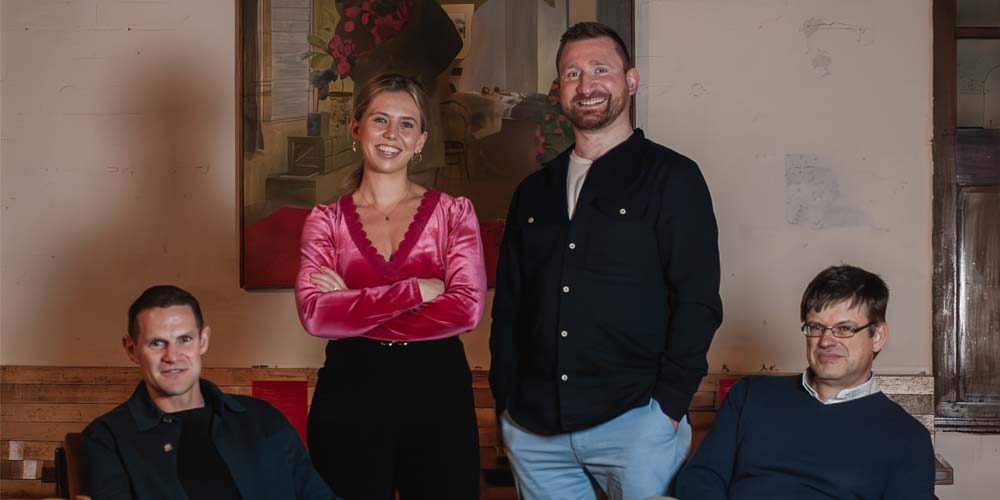

Things are being set up at The Victoria in Neepsend when I arrive. It's the kind of trendy space Sheffield does well these days. Industrial bones, polished but not showy, and buzzing with entrepreneurial ideas and creativity rather than the machinery of yesteryear. In an hour or so, the room will host another Sheffield Angels pitch event, but first I'm sitting down with two of the people behind the network: co-director Andy Evans and Gary Neville, its network manager.
The atmosphere matters. Sheffield Angels has deliberately positioned itself somewhere between serious capital and social connection. Banish any thoughts of hushed boardrooms or intimidating offices. This is networking with a relaxed edge, drinks in hand, conversations flowing, and founders encouraged to be themselves. It is also, increasingly, one of the most exciting early-stage funding gateways in South Yorkshire.
“Sheffield was at the perfect point, really, to have an angel network now,” says Gary. “You had a number of people, like some of the angels that are coming tonight, who had just exited and had some expendable capital to think to themselves, what do we want to do with this? Do we want to put it into stocks and shares, or do we want to reinvest back into the community?”
Andy’s own journey into angel investing began after building, growing and selling a software business in the risk management space. The exit came just before lockdown, a week before the world closed down. Since then, he has been investing through his family office, Mandashi, and joined Cambridge Angels, one of the UK’s most established and successful angel networks.
“They built an amazing network,” Andy says. “They’ve connected with follow-on funds, with a group of angels who have a huge experience in all sorts of sectors, from AI to healthcare. And I thought, this is really fantastic. Why don’t we have something like this in Sheffield?”
For Andy and co-founder Ashley Tate, the absence felt increasingly stark. Sheffield was producing talent from its universities, alongside a growing pool of exited entrepreneurs, yet early-stage capital remained thin on the ground.

“There are lots of accelerators,” he says, “but the problem can be that they only last a year or so and disappear. Whereas what we’re trying to build is something that’s got a lot of longevity to it and sustainability.”
That idea of permanence is central. Sheffield Angels is not a pop-up initiative or a short-term programme. It is explicitly designed to be around in five, ten, even thirty years, following a model similar to Cambridge Angels, which has been operating for decades and has seen founders become angels themselves.
Gary came into the picture from the grassroots end of the startup ecosystem. For several years, he has been running early-stage startup communities and events, including Startup Social, often acting as the first port of call for people playing with the idea of starting a business.

“I was exactly the same as Andy,” he says. “Thinking, why isn’t there any early-stage funding mechanism in Sheffield? It was a desert.”
When Andy and Ashley began exploring the idea of a network, Gary was an obvious fit – along with Rebecca Alcock, the events and membership lead.
It wasn't a difficult sell. “They didn’t even finish the sentence, and I said yes,” recalls Gary.
Both are quick to challenge the assumption that angel investing is simply about writing cheques. Andy’s own experience as a founder shaped that view.
“My business had some angel investors,” he explains. “And the value I got from them was absolutely immense. It’s not just money. It’s about the advice, somebody to talk to when it’s going horribly wrong, or just their network or experience. It’s invaluable.”
That philosophy underpins Sheffield Angels’ approach. Angels pay membership fees. Startups do not pay to pitch. The emphasis is on contribution, not extraction.
“We’re not doing it for just monetary return,” Andy adds. “It’s about how can we make a positive contribution.”
Gary contrasts the angel route with going to venture capital.
“If you go straight to VC, you’re jumping in the big pond. They get control of your business, they don’t give you much advice. Whereas what Andy and Ash are looking at creating here is something that is not just capital. It is also advice from people who kind of care and have got skin in the game.”
Terms matter too. Angel investment is often simpler and more founder-friendly, particularly at pre-seed and seed stage.
“Hopefully they’re not going to take you through an unreasonable valuation,” Andy says. “It’s a very positive way of getting that first step.”
So how do they decide which startups to back?
“If only we knew,” Gary laughs.
The answer, in reality, is diversity. The organisation deliberately looks at companies across different stages and sectors, from very early ideas seeking modest capital and heavy advice, through to more established startups raising larger rounds.
“How do you build an ecosystem?” Gary explains. “You build it in stages.”
In just nine months of activity, the numbers are already substantial. Sheffield Angels has reviewed around 50 startups and invested around £500,000, with co-investments pushing total funding closer to £2 million.

“That’s just great to see,” Andy says. “And we’ve only been going essentially for nine months.”
Sector-wise, the portfolio reflects the city’s strengths. There is biotech, including work linked to the University of Sheffield, manufacturing, and a growing number of AI-led businesses, albeit approached with caution.
“There’s so much growth in that space,” adds Andy. “It’s quite hard to decide which ones are going to be successful.”
Gary agrees, noting a shift back towards hardware and protectable IP.
“I think what we’ll see in 2026 is a bit more of a sensible approach to investing within the AI space,” he says.
Often, though, it comes back to the founder rather than the tech.
“At this early stage, you’re so often betting on the founder,” Gary says. “How good is the founder? How far can they take it?”
Andy looks for something harder to quantify.
“You can sense in some founders this just drive and determination. Failure is not an option. Even if the first product they try to sell isn’t right, they’ll work through that and pivot.”
The pitch events themselves are deliberately structured. There are informal online pitch nights, and more formal dinner pitch events, like the one about to begin at The Victoria, where angels gather to hear three or four startups and then discuss them collectively.
"Even if they don’t get investment, it’s about what advice can we pass forward,” Gary explains. “They might come back in three months or six months with a slightly different proposition, ultimately getting better.”
“Nobody leaves empty handed,” adds Andy.
That collective discussion is one of the network’s most powerful tools. Angels challenge each other’s assumptions, flag regulatory issues or spot opportunities others miss.

“It multiplies the hive mind,” Andy says. “It multiplies investment as well.”
For founders, simply being in the room can be transformative. Gary describes the network as a kind of counselling group for founders who are close to giving up. Sometimes the support is subtle: a calming word before a pitch, a reminder that this is not the only shot.
Both men are clear that Sheffield Angels is rooted in place. This is not a generic angel group that happens to operate in the city. It is explicitly about the future of South Yorkshire.
“I love Sheffield,” Gary says. “It’s given me so much. I came here to start a business, never left. You naturally want to give back.”
There is also a practical economic argument. In difficult times, new businesses drive innovation and growth. Already, Andy has noticed a shift at the grassroots level.
“As soon as Sheffield Angels came about, it felt positive. People had somewhere to go. An outlet.”
As the room fills up, I leave the pair to mingle. Sheffield Angels might still be young, but it’s certainly exciting and already feels embedded in the city’s business fabric.
The long-term ambition is circular. Founders become successful. Some exit. Some return as angels themselves. Knowledge, capital and confidence stay in the region as a result.
There is also work underway to broaden who gets involved, particularly encouraging more female angels through inspiration events and practical sessions on topics like SEIS, legals and IP.
Gary is particularly blunt about the overall objective.
“It’s about building something sustainable, not a flash in the pan. I want it to be the best angel network in the UK. Why not? It’s doable and if we get the balance right, I think that’s what we get to.”
Interested in becoming a member or attending an upcoming pitch event? Head to sheffieldangels.org for more information, or connect with Sheffield Angels on LinkedIn.
Words: Joseph Food Photography: Marc Barker


