unLTD’s Mike Durham chatted with technology expert Daniel Bumby, the managing director of Sheffield’s Simoda, to learn more about how the business’s unique structure has helped them stand out in a crowded IT marketplace
Across all different sectors and industries, businesses today have one key thing in common they likely would struggle to function without - technology.
Even before the pandemic businesses had to rely on technology in some shape or form, whether that was for infrastructure, storage of data, modern workplace, or anything else you can think of, so it’s no surprise that there are endless businesses competing for attention in the IT market.
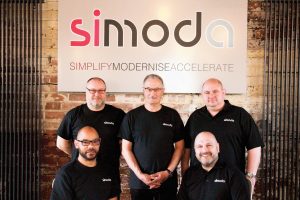 Having been working in the industry for over 20 years, Daniel has plenty of experience when it comes to the do’s and don’ts of IT and technology. It was his time working for other businesses that sparked the idea for a new venture of his own.
Daniel said: “There is that much technology available at the minute that, at the touch of a button, anyone can do anything. As a business, it can be quite challenging when you have to figure out what you should use to solve a certain problem. Typically, when you work with an IT provider, they tend to look at the solution which is the most commercially favourable to them.

“Simoda was built around answering the question of how do we move away from a commercial model whilst still being profitable as a technology business. We don’t have sales targets, we don’t have numbers, we just have a team of skilled experts who’ve been in the industry a long time who’re here to talk about the latest technology to businesses.
“We see ourselves as a technology business, rather than an IT reseller. By removing the commercial aspects, we can fully focus on addressing challenges, solving issues and helping achieve objectives through technology.”
To accomplish their mission, Simoda designed a clear way of distinguishing between different technology products, solutions and service offerings to identify which are the best fit for each customer’s individual requirements.
This was how Simoda’s ‘Value Framework’ was born; a simple structure focusing on important business outcomes which act as critical drivers in any technology decision making process.
After chatting to a business about their challenges and understanding the outcome they’re trying to achieve through technology, Simoda break down the request and review possible products, solutions and services against three key criteria.
The first of these is ‘Commercial Value,’ which asks whether the adoption of technology could offer the business reduced costs, or if it will open up new revenue sources and markets.
 The second, and arguably biggest criteria, is the ‘Technical Value’ the solution can deliver.
This assesses whether technology can improve performance and productivity, as well as reduce any cyber-security risks associated with a business’s services, applications, systems and people.
The final part of the Value Framework focuses on the ‘Emotional Value’ technology can bring to an organisation.
This looks into whether there is a solution which can help the business, and particularly their IT team, relax and enjoy more precious time with their families as they know everything is safely and securely managed.
Daniel said: “We often find when we sit down with a business, and ask them what are your biggest challenges, they tend to say things like ‘making sure the business is up and running, that it’s secure, that it can progress, that it can make money, save money…’
“Then when we ask them about the challenges they have with their personal life around work, it tends to be the time they spend at work, or on call – which with an IT team can often be 24/7.
“If we can provide a technology solution that enables people to have weekends off - which is also commercially valuable, technically valuable, emotionally valuable - there is no reason why an organisation wouldn’t want to take us up on that offer.”
A good example of the Value Framework recently in action is with North-East manufacturing company CA Group, that has just two people in its IT team, and was struggling to recruit more IT staff due to various administration issues.
The company approached Simoda with their challenge and Simoda suggested moving to a cloud-based architecture, which would free up valuable time and move them to an opex IT as a service consumption model where they simply pay monthly for the IT resources they use. This way they can use cash in the bank for other growth investments.
This meant they got a technically-better solution that reduced their costs and saved the IT team having to work weekends, achieving all three criteria of the Value Framework.
Daniel added: “Most of my job over past six to 12 months has been showing other IT professionals how they can embrace change. Most people working in the IT industry get into their role and think they can do everything themselves, and it’s about showing them there are other ways they can succeed.
 “We’ve also had a few instances of talking to a company and they wanted to do something, but we don’t get involved as we don’t think it’s the right decision.
“Commercially, you might think we’re daft as we could have made some money there, but if it’s not right we’re not afraid to tell a business what they’re doing is wrong and show them the correct way to approach a challenge.”
Daniel and the rest of his team must have been doing something right, because the company is now entering its third year in business.
They’ve had some impressive client wins too, including helping with the roll out of five Covid vaccine centres in South Yorkshire by getting them connected to the NHS network.
Simoda’s success led to a grand move last September from a tiny six-man space to a 2,500 square ft office space in a former factory in Kelham Island, just above Domo restaurant.
Daniel said having a creative space for the Simoda team, in a good city-centre based location, was an incredibly important part of achieving both a good work-life balance and a modern feel.
“We’re trying to create a company culture that reflects we’re a technology business. We didn’t want everyone wearing a shirt and tie in some corporate building on the edge of town, that’s too 1980s.
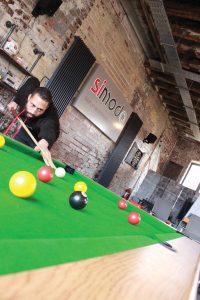
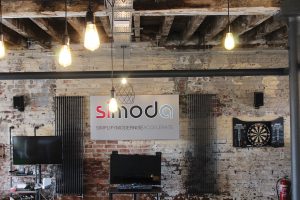
“We’re moving in modern times; we have open brickwork, pool tables, retro game consoles, dart boards, it’s a great working environment and we believe that’s a massive thing.
“We encourage healthy conflict. If anyone has something they want to say we encourage people to just say it, that way we can identify if there is a problem and work to resolve it.
“It’s really important for us that everyone is able to work with a smile. That sounds really boring, but we do like to have a laugh and a joke; you spend most of your life at work so you may as well enjoy yourself.”
Of course, technology tends to evolve at a rapid pace, meaning Simoda’s team are in a constant state of continuous learning as staff need to be aware and accredited in the latest technologies if they’re to identify the most useful software and products.
 Daniel hopes this will prove a vital part of the puzzle in achieving Simoda’s future aspirations which is to help more businesses become ‘disruptive.’
“We as a business need to have the brand names - we have to have the Microsofts, the HPs, the Dells, the Ciscos - but we also decided that we want to focus down on innovation through new technologies to drive ‘disruptive businesses.’
“These are businesses that enter the market providing a service which other businesses are already providing, but doing it in a way that’s completely different, like Uber or Air B&B.
"Our aspiration is to help businesses use technology so they can become an Uber. It’s a cycle; disruption plus innovation, equals transformation.”
To learn more about how Simoda can help you conquer your business’s digital challenges, just head to:
www.simoda.co.uk