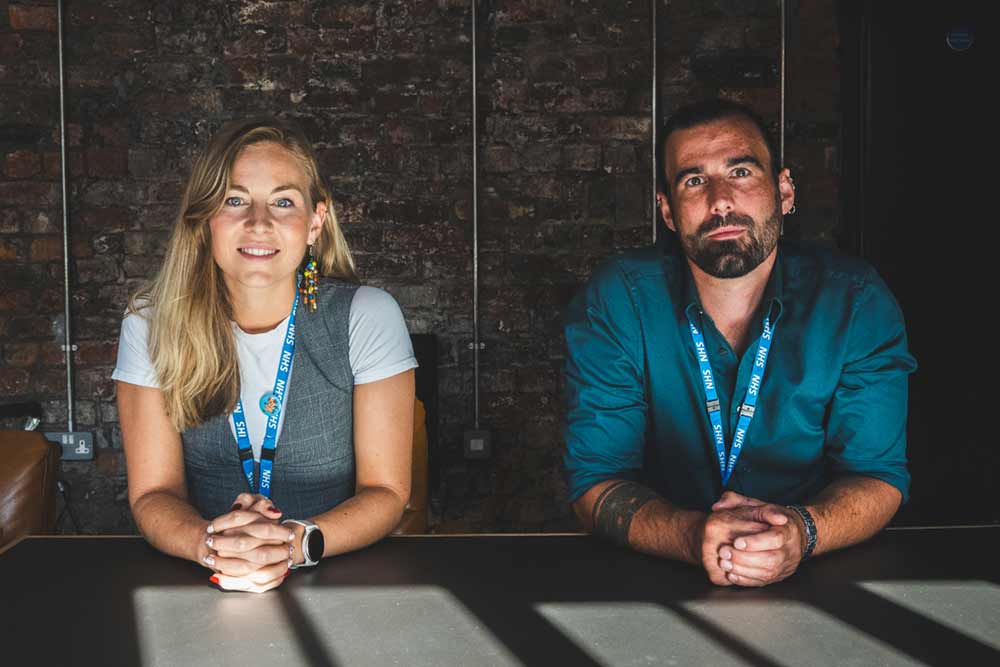
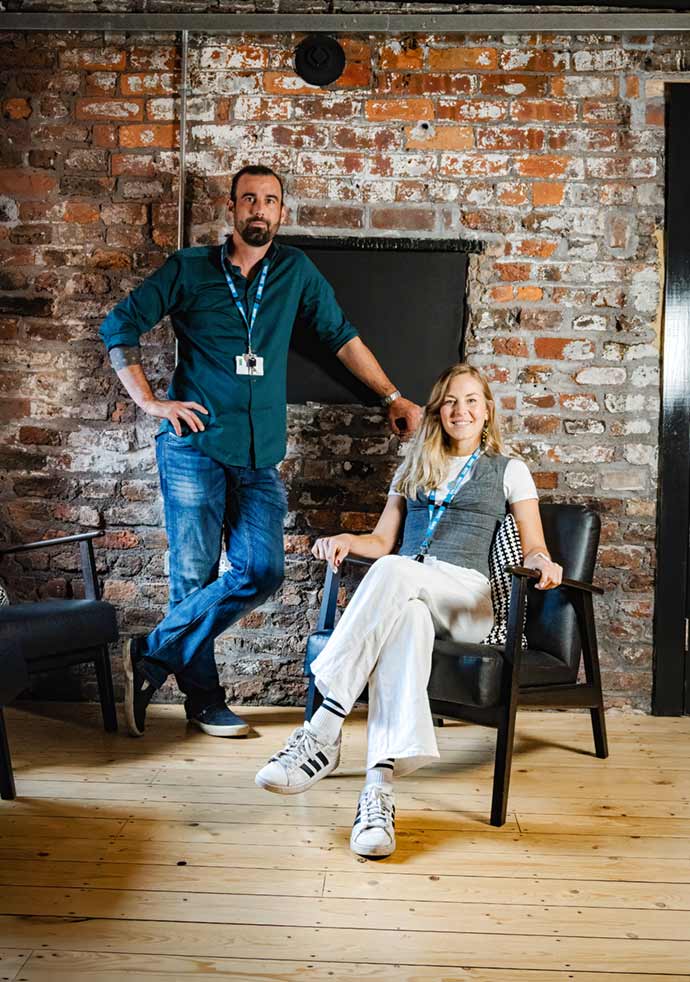
Sheffield Hospitals Charity is inviting businesses and individuals to get closer to healthcare innovation through Sheffield Dragons, a new membership network supporting the charity’s Dragons’ Den Innovation Fund. unLTD spoke to Greg Van Heeswijk, Director of Fundraising, and Rosie Memory, Philanthropy and Partnerships Manager, about creating a community around innovation, giving NHS staff the freedom to test new ideas and how Sheffield’s business community can be part of the journey.
For anyone hearing about Sheffield Dragons for the first time, what is it?
Greg: Sheffield Dragons is a membership network we’re setting up to engage Sheffield businesses and connect them with innovation in healthcare within the city.
It has grown out of the Dragons’ Den Innovation Fund, which we’ve been running with Sheffield Teaching Hospitals for several years and which has been really successful. It was created to give people working within the hospitals an opportunity to develop ideas in an environment where innovation and testing might not otherwise get that chance.
We’ve seen some amazing successes through the fund and we’ve reached a point where we want to give it a sustainable, long-term funding base. Sheffield Dragons allows us to connect businesses in the city with that work and enable them to see the impact their contribution can have.

You describe Sheffield Dragons as a partnership rather than simply a way to donate. What does that mean in practice?
Rosie: For us, it’s about developing a longer-term partnership and making people feel part of the whole journey. That could begin when projects first apply for funding and continue through to seeing them funded and then demonstrating their impact further down the line.
Businesses and individuals can become involved at three different levels – Bronze, Silver and Gold – but the principle behind all of them is that closer relationship. We want members to understand the projects and see what their involvement is helping to make possible.
Greg: There are membership levels and benefits set out in the brochure, but we don’t want it to feel like an off-the-shelf package. We want to work with individual members to understand what would make that partnership valuable for them.
If, for example, an organisation sees an opportunity to provide mentoring and there is a mutually beneficial way of doing that with the hospital, that is something we can explore.
How does the Dragons’ Den Innovation Fund itself work?
Greg: NHS staff from Sheffield Teaching Hospitals (STH) are invited to pitch their innovative ideas to a panel of experts from the senior leadership team at STH as well as senior leaders from the charity. They are judged on what impact their ideas could have for patients, families or staff, and what different outcomes could be delivered for the Trust.
We generally receive far more applications than we can take forward. This year there will be £150,000 available to support successful applicants with their projects.
One of the important things about the fund is that it provides an opportunity to test an idea. Within an environment such as the NHS, there’s a base level of care that has to be provided and a budget available to deliver it. That means people aren’t necessarily going to have the time, money or opportunity to test something new, even when they can see that it might make a difference. The fund creates that opportunity.
Where do those ideas come from?
Greg: They come from people within Sheffield Teaching Hospitals who are seeing these challenges every day. They live and breathe their work and care deeply about it, so what better place is there for an idea to originate?
It’s only right that people have an opportunity to influence the environment they’re working in and some of the processes they have to work with.
There isn’t a narrow limitation on the type of innovation we can support, either. The projects can be very different. Of course, we want as many successful ideas as possible to progress and potentially be rolled out more widely, but testing is valuable in itself. Not every idea necessarily has to become something that is implemented on a huge scale for that process to have been worthwhile.
Can you give us an example of an idea that has already received support?
Rosie: One of my favourites is a wound-management app. A patient can download the app and, if they have a chronic wound, take a video of it while they’re at home. That creates a 3D image which allows their healthcare team to monitor its progress remotely.
It means patients don’t necessarily have to come into hospital as frequently and clinicians can track how the wound is progressing more effectively. Around 2.2 million people across the UK live with chronic wounds, so innovations like that potentially have a much wider relevance.
What I particularly like is that it came from somebody within the hospital having an idea and applying for the funding to develop it.
Greg: The example I always come back to is Snore Safe because it’s really impressive while also being fairly straightforward.
Some people undergoing an operation may have sleep apnoea, which can create complications that need to be considered. Previously, somebody who might be at risk could require further assessment, face a long wait for a test or need to stay in critical care following their operation.
Snore Safe uses relatively inexpensive wearable technology to monitor oxygen levels and heart rate overnight. That can help identify whether sleep apnoea is an issue so the clinical team can make an informed decision about the treatment and monitoring that person needs.
What I find so powerful about that example is the relationship between the relatively small initial investment and the potential saving. The grant we made through the Innovation Fund was around £7,000, but in the first seven months, the project has saved roughly £130,000 through the critical care bed capacity it has freed up. It’s around 12 to 14 critical care beds every month.
When you consider the wider pressures on the NHS and the need to reduce waiting lists, you can see how an idea like that has an impact beyond an individual patient. That broader benefit is something we’re interested in when considering projects.
So are you looking for innovations that could ultimately have an impact beyond Sheffield?
Greg: We’d obviously love to take as many of these ideas forward as possible, and there are examples where we’re looking at ways they might have relevance to other hospitals.
But I think we have to retain that willingness to test ideas. You don’t always get the opportunity to do that within the NHS because the immediate priority has to be delivering care.
Some projects may become something much bigger. Others might demonstrate through testing that there are limitations. What matters is creating a space in which people are able to explore those ideas properly.
You’re preparing to launch Sheffield Dragons. What can prospective members expect?
Rosie: Members can expect our first launch event to take inspiration from TV's Dragons' Den, in an industrial style location in Sheffield.
At the event, we want to look back at some of the things the Innovation Fund has supported previously, but also look forward to what could emerge from this year’s applications. Members will get to hear from senior staff at STH and have the opportunity to connect with like-minded people passionate about supporting health innovation in our region.
How important is Sheffield’s wider business community to what you’re trying to achieve?
Rosie: It’s really important. We want Sheffield Dragons to feel as though it belongs to the business community and to people across the region. It’s about showing that businesses and individuals are willing to invest in healthcare innovation here.
There’s also a circularity to it. When businesses invest in better healthcare in Sheffield, they’re potentially investing in something that could benefit their own staff, colleagues and families. Better healthcare is something everybody in the city can ultimately benefit from.
Greg: We were very conscious when we started designing Sheffield Dragons that we didn’t want to create it in isolation and then simply present it to businesses.
We spoke to a number of businesses across the city and asked for their input about what would work for them. We had some really positive feedback, and that has helped shape what we’re developing.
Rosie: Richard Stubbs, chief executive of Health Innovation Yorkshire & Humber, is also involved as our ambassador. He’s a real pioneer of health innovation and brings a huge amount of knowledge and credibility.
Richard was one of the first people to emphasise that this should be seen as a partnership, not a donation. That has become really important to us because we want members to be involved and genuinely feel part of what’s happening.
Is Sheffield Dragons primarily aimed at businesses?
Greg: Businesses are naturally a major audience for us and we tend to talk about Sheffield Dragons from that perspective, but it certainly doesn’t have to stop there.
There will be people who have had extremely positive experiences within Sheffield’s hospitals and want to find a meaningful way to support them. Sheffield Dragons could offer that.
It could be a philanthropist, an investor or somebody with an angel-investor mindset who is particularly interested in innovation. Anybody who identifies with that should get in touch. It isn’t exclusively about organisations.
What would success look like for Sheffield Dragons?
Greg: For me, it’s about creating a genuine sense of community and bringing together a group of people who are committed to and passionate about healthcare in Sheffield.
We’re not looking for a huge number of members. I’d rather see us create a relatively small, engaged community of people who are genuinely interested in the idea and want to be involved.
Obviously, successfully funding the programme is important. But if we can build that community around it as well, that would represent real success for me.
Where would you like Sheffield Dragons and the Innovation Fund to be in five years' time?
Greg: It might sound ambitious, but I’d love us to double the fund. In the future, if we could commit £300,000 each year to the Dragons' Den Innovation Fund, that would be amazing.
That would give us the ability to support more ideas and create more opportunities for innovation within the hospitals.
Rosie: That would be the dream. We know there is an appetite for innovation and there are always more ideas than it is possible to support.
We’d also like Sheffield Dragons itself to build momentum year on year. As those relationships develop, there are other things we’d love to introduce, such as mentoring and different ways for members to contribute their expertise as well as their financial support.
Finally, if a business or individual likes the idea, how easy is it to become a Sheffield Dragon?
Rosie: Really easy. The starting point is simply to get in touch with me. We'll have a conversation about what level of involvement is right for them and what aligns with their own objectives.
We can share more stories about projects that have received funding in the past and explain what their involvement would actually look like.
It doesn’t need to begin with somebody knowing exactly what they want. The important thing is starting that conversation.
Greg: Ultimately, we want each partnership to work for the member as well as for the charity and the hospitals. The membership structure gives us a starting point, but there’s scope to develop relationships beyond that.
If we can bring together people from across the region who want to invest in the ideas coming directly from those working in our hospitals, we can give those ideas an opportunity to flourish. That’s what Sheffield Dragons is really about.
For more information on Sheffield Dragons and how to sign up, head to sheffieldhospitalscharity.org.uk/sheffield-dragons.